Get a Quote
For Your Commercial Painting or Floor Coating Project!
Thank you! Your submission has been received!
Oops! Something went wrong while submitting the form.
X
Maximizing Durability with Commercial Epoxy Floor Coatings
Maximizing Durability with Commercial Epoxy Floor Coatings
Commercial flooring faces constant wear from foot traffic, equipment, cleaning routines, and daily operations. Property managers depend on long lasting surfaces that can handle these demands without constant repair work. This is why commercial epoxy floor coatings have become a top choice for facilities that need strength, safety, and a clean appearance. These systems offer a reliable way to protect concrete and extend its lifespan while giving property managers a practical solution that aligns with budget and maintenance needs.
This guide explains how commercial epoxy floor coatings work, what makes them durable, and why they have become an important upgrade for many commercial buildings. The information is designed for property managers who want to understand the benefits before arranging a professional installation.
What Makes Commercial Epoxy Floor Coatings So Durable
Commercial epoxy floor coatings are created by combining a resin and a hardener that form a solid, protective surface. Once applied to concrete, the coating bonds tightly with the substrate and cures into a dense layer that can handle regular stress. This bond is a major reason commercial epoxy floor coatings last longer than standard concrete sealers or paint.
The durability also comes from the way these coatings resist impact, stains, moisture, and chemicals. Many commercial buildings handle carts, hand trucks, industrial cleaners, and spills that can break down unprotected concrete. Epoxy stands up to these conditions because the cured surface creates a barrier that does not absorb liquids or soften when exposed to cleaning agents.
Key Benefits Property Managers Gain From Commercial Epoxy Floor Coatings
Property managers look for flooring upgrades that solve daily challenges and reduce long term costs. Commercial epoxy floor coatings support these goals in several ways.
Improved strength
Commercial epoxy floor coatings provide a hard surface that holds up well in maintenance rooms, storage areas, mechanical spaces, loading areas, and other parts of a building that experience frequent activity. The coating reduces surface wear so concrete stays smooth and intact for a longer period of time.
Better safety
Safety is a major concern for most commercial facilities. Commercial epoxy floor coatings can include slip resistant additives that help reduce fall risks in areas that may become wet. They also create a bright, reflective surface that improves visibility which can help with both foot traffic and equipment movement.
Moisture protection
Concrete naturally absorbs moisture which can lead to cracks, surface damage, and early deterioration. Commercial epoxy floor coatings seal the surface so water or cleaning solutions cannot seep into the slab. This protection is valuable in janitorial closets, kitchens, break rooms, and anywhere spills are common.
Cleaner appearance
Commercial epoxy floor coatings give facilities a polished, uniform look. Many property managers prefer them in areas visitors or tenants see often because they make the space look well maintained. The coatings resist staining which helps maintain a clean appearance even in high traffic areas.
Where Commercial Epoxy Floor Coatings Work Best
These coatings can be used in many commercial settings. Knowing where they perform best helps property managers plan upgrades effectively.
Retail and tenant spaces
These locations see steady foot traffic throughout the day. Commercial epoxy floor coatings handle constant use without chipping or fading which keeps the space looking professional.
Industrial and warehouse areas
Warehouses and industrial properties require surfaces that withstand equipment movement, loading, and occasional impact. Commercial epoxy floor coatings offer a solid base that supports daily operations.
Parking garages
Parking garages face tire marks, oil drips, and moisture from vehicles. Commercial epoxy floor coatings give the concrete a protective barrier that holds up well in these conditions.
Healthcare and education buildings
These facilities need clean, sanitary spaces that are easy to maintain. Commercial epoxy floor coatings work well because they are resistant to spills and can be cleaned quickly.
Office buildings and common areas
Common areas need a surface that stays attractive with minimal upkeep. Commercial epoxy floor coatings provide a smooth look that contributes to the overall appearance of the building.
How Commercial Epoxy Floor Coatings Help Reduce Maintenance Costs
Long term value matters to property managers. Commercial epoxy floor coatings help lower maintenance spending by reducing the need for patching, resurfacing, or frequent cleaning. Concrete that lacks protection breaks down faster which leads to cracks, stains, and uneven areas. Repairing these problems takes both time and money.
Commercial epoxy floor coatings protect the slab so it needs fewer repairs over time. They also make regular cleaning faster because dirt and spills stay on the surface rather than soaking in. Staff can mop or scrub the floor without heavy chemicals or deep cleaning tools. This creates savings that add up over the lifespan of the coating.
Steps Property Managers Can Expect During Installation
Understanding the installation process helps property managers plan for downtime. Professional installation of commercial epoxy floor coatings typically involves these steps:
Surface preparation
The concrete must be cleaned and sometimes ground to create a smooth, receptive surface. Any cracks or holes are repaired so the coating can adhere properly.
Primer application
A primer coat helps the epoxy bond to the concrete. It also helps prevent bubbles and creates a uniform base.
Applying the epoxy layers
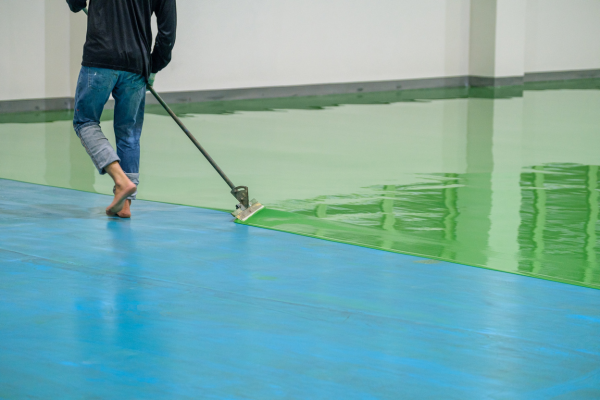
The installer spreads the epoxy evenly across the surface. Some projects require multiple layers depending on the level of durability needed.
Adding safety features
If slip resistant additives are included, they are applied before the coating cures.
Curing time
The final coating must cure before people walk on it or equipment moves across it. Cure time varies by product but is often completed within a few days.
Why Professional Installation Matters for Commercial Epoxy Floor Coatings
While epoxy products are sold at many stores, commercial epoxy floor coatings should always be installed by professionals. A commercial facility requires precision to achieve the correct bond, surface smoothness, and long term performance. A professional team has the training and equipment needed to prepare the concrete correctly which is one of the most important parts of the process.
Professionals also know how to choose the right epoxy system based on the type of building, traffic level, and safety requirements. This knowledge helps property managers get the best value from the investment and avoids issues that come from improper installation.
How Long Commercial Epoxy Floor Coatings Last
With proper installation and upkeep, commercial epoxy floor coatings can last many years. High traffic areas may need re coating sooner but most commercial coatings remain effective far longer than traditional paint or sealers. The lifespan depends on how often the area is cleaned, what type of equipment moves across the surface, and whether any harsh chemicals are used. Regular inspections help identify early signs of wear so the coating can be refreshed before deeper damage occurs.
Contact PPD Painting Today
Commercial epoxy floor coatings give property managers a dependable way to strengthen concrete, reduce maintenance costs, and improve the appearance of their buildings. These coatings perform well in many commercial settings and provide long lasting protection that supports daily operations. If you want to upgrade your facility with commercial epoxy floor coatings, contact PPD Painting to schedule a consultation and learn how these systems can support your building needs.
FAQ
What is the typical lifespan of commercial epoxy floor coatings?
Most systems last several years depending on foot traffic, equipment use, and cleaning routines. High use areas may need re coating sooner but the surface still holds up longer than standard sealers. Regular inspections help maintain performance.
Are commercial epoxy floor coatings safe for high traffic areas?
Yes, these coatings can include slip resistant materials that improve traction in busy spaces. They also create a bright surface that supports better visibility. This makes them a strong option for hallways, entrances, and shared areas.
How long does installation of commercial epoxy floor coatings take?
Most projects take a few days from preparation through final curing. The exact timeline depends on the size of the space and the number of coating layers. Property managers can plan limited downtime during installation.
About The Author

Aaron Moore
Aaron Moore is at the forefront of PPD Painting, bringing a fresh perspective and a commitment to excellence in the painting industry. With a keen eye for detail and a passion for transforming spaces, Aaron has led PPD Painting to become a trusted name in commercial and residential painting services. His approach is centered around quality, customer satisfaction, and the use of environmentally friendly paints and processes. PPD Painting is committed to not just meeting, but exceeding client expectations, offering guidance on color selection, maintenance, and the latest trends in paint technology and application.
Ratings & Reviews

"Lorem ipsum dolor sit amet, consectetur adipiscing elit. Suspendisse varius enim in eros elementum tristique. Duis cursus, mi quis viverra ornare, eros dolor interdum nulla, ut commodo diam libero vitae erat."

Name Surname
Position, Company name


Really like this service. Great pricing
Alex Wong
Well, nothing in this life seems to be perfect, but Precision Painting is nearly there.
Karen Fenyn
Very responsive. Quality work. Helpful staff!
David Wilson
Work was great. Professionally completed job. Workers were great and a pleasure thru the mess.
Kathie
Exceptional work! Ricardo did a great job. The office staff and project manager as well as Aaron were all very helpful and accommodating.
Marikay Artner
On time, professional, pleasant, hard working and thorough job.
Maura Cullen
You came here and gave us the estimate when you said you would. Your project leader was polite and on time.Your crew was here on time, they were polite and got to work right away and did a good job. The job was completed when you said it would be finished.
Joe Lambert
Very detailed, quality work, responsive, prompt, pleasant to work with.
Kurt Nitschke
First time using, but very pleased with everything. Great crew did a great job, reasonable pricing, flexible hours with minimal effect on our staff
Robert Wallace
You have experienced, professional painters who genuinely care about the quality of their work.
Ann R.
The crew was very professional and courteous.
Kim Baker
Bruno is doing a good job in his new roll as project manager and Sal is the best painter that leads the crews for Phonak work projects. I get them started and they take it from there with very little monitoring on my part. I also like the partial billing, the organizing of my paints and if possible a year end report on what we spent on patching and painting would be great.
Mike Moore
Excellent workmanship, I didn't have to check your work. Paul and Alfonso were polite, and conscientious and treated my house as if it was their own.
Rick Orna
Answered their phone promptly. Paint job was a perfect match. My customer was very pleased.
BRS
Paul is an excellent painter. He was very tidy and easy to work with. Paul did a great job matching the color of our front stain and his work is professional. Paul was on time and good at communicating. I would definitely recommend Precision Painting to a friend.
Tracy McCarville
Quality efficient work
Brent Alwood
Great Professional Work!!
James Kastanis
On time, good job, neat, good clean up
Joyce Helms
Friendly professional staff. Quick scheduling of both quote and job. Quality work at finish!
Amy Barger
On time, on budget with a high degree of quality.
Richard Dusing
Great painters did a thorough and complete job. Staff was commenting on how good they were.
John Pena
The crew did an unbelievable job on our home.
Brian Germain
By far the best team I have worked with on home improvements -- I'd describe them as professional, timely, courteous, talented, and fun!
Kevin Slattery
They were extremely professional, organized and finished the job in half the time! Highly recommend their service again :)
Valentina Labovic
Very good execution and quality.
Bob Sanner
Great company; professional and courteous. It was clear the team knew how to do their job and took pride in doing it well. Very organized and efficient as well.
Pat Shaughnessy
Always prompt, professional, reasonably priced, great work, communicates well with you!
Mary Della Chiesa
Great job and extraordinarily kind gentlemen doing the work. Had the utmost respect for our home.
Eileen Daw
Great workers and very friendly.
John Pena
PPD was professional, prompt, clean and fairly priced. Recommend 100%!
Jack Dominy
Great experience from start to finish, from scheduling the estimate, work well done, polite & professional painters, cleaned up afterward
Christine Futrell
Professional, responsive, does great work!
Kurt Nitschke
Excellent service and quality work at a fair price....
Dan Abdo
You guys do great work, are reasonably priced, and stand behind your work and all your people are good to work with. I will mention that on the last few jobs I noticed a very slight slip in the finished quality, things like drips or missed spots. No big deal but something I don't expect from you guys.
Bernard Bartelli
Terrific and conscientious quality of work plus cleanup.
John Michie
Good job and very easy to work with!
Ilsa Conover
Great friendly staff and quality painting pros.
Christine Paulson
Good job Finished on time
Pat Rossi
The work was outstanding and the employees were amazingly courteous, professional and personable.
Eva Roby
Very nice job can’t wait til do the outside
Dennis Hansen
Inspiration Gallery


